SUMMARY:
Article by Chrystabel Procter profiling her sister Joan B. Procter's lifelong dedication to herpetology, including training under Dr. G. A. Boulenger, publications, and society fellowships. It notes her upcoming role as Curator of Reptiles at the Zoological Gardens and her design work for aquarium rockwork at the Mappin Terraces.
CONTENT:
THE WOMAN'S LEADER.
AUGUST 10, 1923.
A WOMAN HERPETOLOGIST.
By CHRYSTABEL PROCTER.
Entomology and other branches of zoology can be, and often
are, begun comparatively late in life, but the herpetologist is
born a herpetologist.
As soon as she was old enough to express her thoughts, my
sister (Joan B. Procter) announced that she intended to spend
her life in the study of reptiles, and until now she certainly has
kept her word.
From ten to eighteen, she was educated at St. Paul's Girls'
School, where her ambition was treated sympathetically, though
I do not think anyone took it very seriously. She was
taught no biology—zoology was not included in the curriculum
until the term after she left, but she was allowed in the higher
forms to specialize in Geology, Physics, Chemistry, and Mathe-
matics. Out of school, almost the whole of her time was spent
in studying zoology.
She kept a large collection of reptile pets, from the time she
was a small child, and has always had the knack of taming them
very quickly. She believes she is safe with snakes, because
she has no fear of them. It is fear, she says, that makes the
danger. Young children are not, as a rule, afraid of reptiles
until made afraid by adults. At eighteen, her scientific education
began at the Natural History Museum, where she had the amazing
good luck to be trained for three years by Dr. G. A. Boulenger.
No other training could have fitted her so well for the work she
is doing now. I have heard her say many times that she owes all
her success to his patience and kindness. Dr. Boulenger was
the greatest living authority on reptiles, batrachians, and fish;
and in recent years has become a distinguished botanist.
My sister first met him when, as a child, she took a small
pet crocodile to the Museum to be named correctly. Other
visits followed and, when she left school, she went to work under
his supervision. Besides teaching her science, he encouraged
her to do independent research work, and instructed her in
the routine work of the Museum. She read papers before the
Zoological Society—the first when she was nineteen, and she
had much practice in the working out and naming of collections
from foreign museums.
When Dr. Boulenger retired in 1920, he arranged that she should
carry on his work, and this she has done ever since.
Her duties have included routine work such as the writing up
of reports, registers, and catalogues; the answering of letters
from all over the world on the subject of reptiles and batrachians;
the naming of museum and private collections; the describing
of new species, and the general supervision of students of
herpetology.
Some 3,000 specimens have passed through her hands; she has
published many scientific papers and compiled the Zoological
Record (Reptiles and Batrachians) for 1920 and 1921.
She is a Fellow of the Zoological Society of London, the
Linnean Society, and the Bombay Natural History Society.
At home she has kept a private collection of living creatures,
which has latterly included rare and delicate batrachians from
collectors abroad.
Her work as Curator of Reptiles at the Zoological Gardens
will commence in November, and will include care of the living
collection and research. She is looking forward to it very much.
It is not usual in England for a woman to be offered such a post,
or to have enjoyed such training, and my sister feels herself to
be unusually fortunate. Abroad, however, especially in America,
there is more scope for women. A Miss Dickerson was for some
time head of the Department of Herpetology in the New York
Museum, and Dr. Nelly de Rooij now holds a similar position
in Leiden.
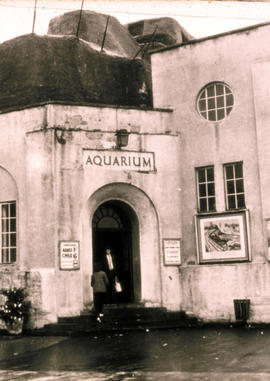
My sister is at present engaged in designing the rockwork
for the tanks in the new Aquarium, under the Mappin Terraces,
at the Zoo. This has, of course, nothing whatever to do with
her herpetological work. There are to be about sixty tanks,
all different, and each one geologically correct and suited to the
habits of the creatures which are to live in it. The designs
include studies in many kinds of natural rock. My sister makes
small models, scale two inches to the foot, and these are copied by
craftsmen.