Aperçu avant impression Fermer

Affichage de 60 résultats

Description archivistique
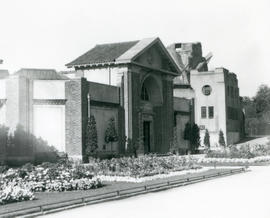
Plans of Old Lion House
ARC/1/1 · Dossier · 1975
Fait partie de Architecture and buildings

2 large prints of the survey of the old lion house, originally designed by Antony Salvin Jr (1875-7) which was replaced by the New Lion Terraces in 1976

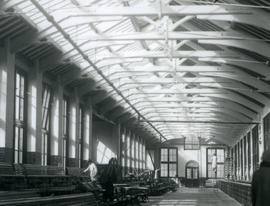
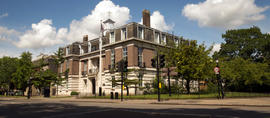
ZSL Main Office plans
ARC/3/1 · Dossier · 1909-1910, 1964-1967
Fait partie de Architecture and buildings

Plan, section and elevation drawings relating to the construction of the ZSL Main Offices (and Library) at Regent's Park, dated January 1909 to March 1910. Included are details of elements reused from Hanover Square. Alterations to Library, 1964-1967. Some hand annotations and doodles. Architect/engineer/designer: J Belcher, Architect; Werner, Pfleiderer & Perkins Ltd, Engineers; J Jeffreys & Co, Heating and Ventilation Engineers; A Smith & Stevens, Lift Engineers. 

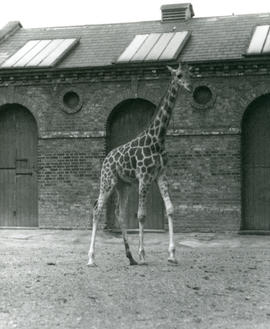
Giraffe House plans
ARC/15/1 · Dossier · 1960-1961
Fait partie de Architecture and buildings

Plan and section drawings relating to the remodelling of the Giraffe House, London Zoo. Some hand annotations. Architect/engin

CUR/3/3/3/4 · Partie · 1923-09-23
Fait partie de Curators and Keepers

SUMMARY:
A Public Ledger feature profiles Joan Proctor, curator of reptiles at the London Zoological Gardens, detailing her compassionate methods for handling snakes and her role in designing a new reptile house. The article shares anecdotes about boas and king cobras, feeding challenges in zoos, and public reactions to her work.

CONTENT:
PUBLIC LEDGER—PHILADELPHIA, SUNDAY MORNING. SEPTEMBER 23, 1923

Her Playmates are Ugly King Cobras!

Miss Proctor finds a handker-
chief useful for securing a grip
on the tail of a poisonous snake
friend that might become too
playful

Miss Joan Proctor,
Curator of Reptiles
in the London
Zoological Gardens,
Tells How She
Overcomes Her
Serpentine Pets With
Sheer Kindness

THE first woman in the world was on
sociable terms with a serpent, and
the world knows what came of that.

But here is one of Eve's youngest
daughters handling, petting and caring
for innumerable descendants of that wily
snake of old. Her name is Joan Proctor
and her official title is curator of reptiles
of the London Zoological Gardens.

The feeling that soft, purring, cuddly
little kittens awaken in other small girls
came to Joan when, as an inquisitive
ten-year-old, she first made the acquaint-
ance of a shining, wriggling green
garter snake, and that strange fondness
for the first enemy of man has grown
and grown until her greatest joy in life
is playing foster-mother to all the alli-
gators, toads, turtles and reptiles in
London's famous Zoo.

The family in which Joan belonged
didn't exactly favor the predilection of
its youngest member for crawling things,
when that first slimy, glassy-eyed
creature was introduced into their happy
home. But Joan was a positive little
person. She made it plain that her mot-
to was "Love me, love my snakes!"
and presently the whole Proctor clan
progressed from abhorrence to indiffer-
ence. They could put their hands into
a presumably empty vase on the living
room table, touch the cold coil of a snake
and not fall in a faint.

From indifference, the Proctors went
on until they began to share Joan's un-
canny affection for creeping things, and
now her home would not be home with-
out at least three boa constrictors
draping themselves about the furniture.

When Joan was seventeen she read
her first paper about snakes before the
Royal Zoological Society—a paper that
attracted serious attention. A few years
later, she became the unsalaried assistant
of the curator of reptiles at the
British Museum of Natural History—
truly a labor of love. In the museum
laboratory she worked and studied amid
hundreds of jars and bottles containing
creeping things. And all the time at
home she watched over the boas, the
bushmasters, the asps and the black
snakes that succeeded each other at
home as the darlings of her heart.

SO IT was that when the council of
the Royal Zoological Society found
it necessary to engage a new custodian

Eve in the Garden of
Eden was the first woman
on friendly terms with
the serpents, and so it has
come to pass that in this
day, many years after the
creation, there are daugh-
ters of Eve who do not
find it so distasteful to
train serpents and care for
them tenderly

Miss Proctor believes a daily "air-
ing is good for any household
pet. Here she is with a pet rep-
tile which she has taken for a
walk through the grounds of her
London home

for its great collection of living reptiles,
Joan, whose paper on snakes read be-
fore that august body so early in her
career had made such an impression,
was unanimously decided upon as the
logical recipient of the honor,

"It's a very simple thing to get on
with reptiles of any sort," says the
new curator, illustrating her point by
using one of her favorite poisonous-
tongued friends as a neckpiece. "By
using a handkerchief to make sure of
my grip on his tail, he can't get too
playful, you see. The dear things do
love to twist themselves about people's
necks, and then sometimes they squeeze
too hard." Which, it may be clearly
seen, is not so good for the neck.

"Kindness and real understanding are
back of success with snakes," decrees
the only woman occupant of a position
of such scientific note in Great Britain.
So great is the confidence reposed in
this young woman by those who know,
that she is not only to care for the huge
creeping things of the jungle, but has
been empowered to design the new home
for reptiles at the London Zoological
Gardens, and is now engaged in deciding

The neck of a human being is just the sort of a
"warmer" that a tropical snake
loves to coil about—and
squeeze—so Miss Proctor
adopts the simple "Safety
First" measure of holding the
head and tail securely as she
handles this small but surpris-
ingly powerful boa

When, as a ten-year-old girl, Joan
introduced her first creeping pet
into the Proctor household, her
parents were not at all inclined to
approve the strange friendship,
but Joan's persuasive powers over-
came that difficulty. Snakes of
varying lengths and colors have
since established friendly relations
with all members of the Proctor
household. Here is Joan's mother
demonstrating the innocent inten-
tions of a twelve-foot boa

constrictor just then draped about her
neck.

A neck, Miss Proctor explains, is
an ideal "warmer" for a tropical
snake. There's nothing he likes better
than to coil about it. Coping with Mr.
Boa in this case means keeping a firm

—usually expensive and difficult to ob-
tain—and that only will they swallow.
How to combat this suicide tendency
in reptiles will probably engross Miss
Proctor as it engrosses most curators
of these temperamental creatures. Ray-
mond L. Ditmars, of the New York Zoo,
reports that a continual offender in this
regard is the bushmaster.

King cobras are another variety of
Miss Proctor's charges likely to become
obnoxious at times. Or, at least, that
has been the experience of other cura-
tors.

When this monarch among snakes
arrived at the Bronx Zoo, he registered
his dislike of the institution and his
objection to remaining in it by refusing
to eat at all. As he is a cannibal, he
was offered every species of crawling
thing the authorities had ever heard of
a cobra eating. But no! Nothing
doing! Never in this world, so said the
cobra in question, if his expression mir-
rored his thoughts.

At length a "coach whip," a nice, five-
foot appetizing morsel, was sent in for
the rebel's breakfast. That hit the spot.
The king cobra ate it and demanded
more of the same. And there the scheme
struck a snag, for coach whips cost
three dollars each and aren't to be had
at all times for a striking monarch's
fastidious taste.

What was to be done? The diet of
coach whip had been kept up while the
curator engaged in thought, and now
long, thin strips of beef were cut in the
length of the favorite food, and each
strip covered with one of the old skins
the coach whip had shed. The skin
was tied about the beef at intervals and
the strips were offered to his majesty
for the next meal. And he ate them.

Diplomacy, as will be seen, belongs
not alone to court and political circles.

Snakes are not the only pets to be found in Miss Proctor's home. Pussy jumped upon a
table to see what this tricky boa was doing. The boa turned its head away as if it had not
the slightest interest in the cat's presence. The photographer snapped just before the lightning-
swift strike that was sad news for pussy

just where, what and how big the quar-
ters for her favorites shall be,

"Woman snake-charmer!" shrieked
local newspaper headlines, when this
announcement was made.

"I'm not!" contradicted Miss Proctor,
showing a surprising little glint in her
eyes—a glint that may be the secret
of her power over the descendants of
that serpent that tempted Eve.

"You might call me a 'snake-keeper,

if you will, but not a snake-charmer.
Do you know what a snake-charmer
is? Some queer voodoo sort of person with
supernatural powers. Of course, I'm not
that! It's so easy to get on with snakes.
Why, if you've learned the way to deal
with a two-foot garter snake, you know
how to cope with an eight-foot python!
They are all so much alike." The foster-
mother of London's reptiles caressed the
fine head of the amazingly powerful boa

grip on head and tail so that his en-
thusiasm for the human eater doesn't
carry him too far.

"There are many problems for this
little woman with the big nerve to solve,
for snakes who come from other lands
as captives are likely to behave er-
ratically as human beings under similar
circumstances. They go on hunger-
strikes. They commit suicide. They
demand one certain kind of food

THERE are about one thousand species
of snakes in the world and a goodly
portion of them are represented in Miss
Proctor's collection. There is, for in-
stance, a twenty-foot python, weighing
three hundred pounds, and a mere
specimen of burrowing snake but five
or six inches long and no thicker than
a goose quill. And there is a squatty,
flat-headed viper and an enormously
elongated tree snake—and goodness
knows how many more.

What's the good of snakes if you don't
happen to love them for themselves
alone, as does Miss Proctor?

California says they're good for ex-
terminating gophers that destroy the
crops on the Pacific Coast. Australia
applauds reptilian efforts to help them
get rid of the vermin plague, result of
accumulation of stocks of wheat because
of non-shipment during the war. Green-
wich, Connecticut, urges that snakes be
used to keep mole-infested lawns in
order. And the departments in Wash-
ington point out that rats are the great-
est destroyers of wheat the world ever
knew, and snakes live on rats to a great
extent!

So Miss Joan Proctor is not alone in
her opinion that snakes are well worth
cultivating.

CUR/3/3/3/9 · Partie · 1923-07-19 - 1925-07-20
Fait partie de Curators and Keepers

SUMMARY:
Clippings announce E. G. Boulenger’s promotion to Director of the new aquarium and Joan B. Procter’s appointment as Curator of Reptiles, outlining her background and expertise. Additional coverage describes progress and features planned for the new aquarium.

CONTENT:
THE TIMES, THURSDAY, JULY 19, 1923.

Mr. E. G. Boulenger has been appointed
Director of the new Aquarium at the Zoo,
and Miss Joan B. Procter has been appointed
Curator of Reptiles. (p. 9)

WOMAN CURATOR OF
REPTILES.

APPOINTMENTS AT THE
ZOO.

Mr. E. G. Boulenger, at present Curator of
Reptiles at the Zoological Gardens, has been
appointed Director of the new Aquarium.
He will continue to exercise a general super-
vision over the reptiles, but for some time he
has been very fully occupied with superintend-
ing the construction of the aquarium, and
when the tanks are ready for occupation it is
anticipated that his time will be almost com-
pletely engaged by his new duties. Mr.
Boulenger is a son of Dr. G. A. Boulenger,
F.R.S., for long chief of the Department of
Reptiles, Batrachians, and Fishes at the
British Museum of Natural History. Since
Mr. Boulenger has been Curator at the Zoo
the reptile-house has been greatly improved,
and the collection made one of the finest in
the world. During the war he served in
France with the balloons.

Miss Joan B. Procter, F.Z.S., F.L.S., has
been appointed Curator of Reptiles, and will
assume her duties in late autumn. She was
educated at St. Paul's School for Girls, and
since 1916 has worked in the Reptile Depart-
ment at the British Museum, first as voluntary
assistant to Dr. Boulenger, and, since his
retirement, in charge. She is the author of a
large number of papers on the anatomy,
classification, and habits of reptiles and
batrachians, and for many years has kept a
private collection of living snakes and batra-
chians. At present Miss Procter is still carry-
ing on the work of the Reptile Department
at the Museum, but is also engaged in design-
ing the rockwork for the aquarium tanks at
the Zoo.

Cutting from the Hull Daily Mail
Address of Publication.
Issue dated. 20.7.25

Miss Joan Procter, F.Z.S., F.L.S., an Englishwoman
of 25, has been appointed curator
of reptiles at the Zoo. She will have com-
plete charge of dozens of venomous cobras,
deadly pythons, boa constrictors, alligators,
and crocodiles. Miss Procter, unknown to the
world at large, is famous among zoologists as
one of the greatest snake experts of the day.

THE EVENING STANDARD.

ZOO AQUARIUM
PROGRESS.

NEW CURATOR ON WONDERS OF
COMING ATTRACTIONS.

£50,000 COST.

HOW LONDONERS WILL SEE
SEALS UNDER WATER.

Mr. E. G. Boulenger, the curator of rep-
tiles at the Zoological Gardens, who has
been appointed director of the new aquarium
which is expected to be completed at the
end of the year, gave some interesting de-
tails in an interview to-day of the progress
of the work.

Mr. Boulenger is a son of Dr. G. A.
Boulenger, F.R.S., formerly chief of the de-
partment of reptiles and fishes at the British
Museum of Natural History, South Kensing-
ton.

One of the Finest in the World.

"We began building the aquarium," he said,
"at the beginning of December. When it is
finished—we hope before the end of the year—
the aquarium should be one of the finest in
the world. It is being built under Mappin Ter-
races, and the tanks have been supervised by
myself and Miss Joan Procter, who has just
been appointed Curator of Reptiles, and is
taking over my duties in the autumn.

"The aquarium will be for fresh water and
marine animals, and the tanks will be faced
with plate glass 1¼ inches thick. This glass is
very expensive, and is a big item in the total
cost of £50,000.

"We are getting our sea-water from the Bay
of Biscay, and it will be brought in the ballast
tanks of large vessels to the docks and trans-
ferred there to barges, which will bring it up
along the Regent's Canal to the Zoo. It will be
piped from the barges into the tanks by means
of long fire hoses.

"Mr. Compton Mackenzie has given us a
quantity of shell sand from the Island of Herm
which he owns for some of the tank floors. This
shell sand is remarkable, for every grain is a
tiny shell.

Open Trout Pool.

"We will have an elaborate system of reser-
voirs, filtering arrangements, and plant for
heating, lighting, and ventilating, and the
aquarium, which will be 400ft. long, will be
divided into three parts.

"The fresh-water hall will have 25 tanks, the
marine hall 20, and the tropical hall 40. We
will have an open trout pool, a big octagonal
tank for marine turtle, and a tank for seals
under water.

"We will have a wonderful collection of
tropical fish brilliantly coloured and equal to the
finest in the world.

"Not even the New York Aquarium will sur-
pass it in the beauty of its contents."

The new aquarium, when it is completed, will
probably prove one of the biggest attractions at
Regent's Park.

Miss Procter, the new Curator of Reptiles,
was educated at St. Paul's School for Girls,
and since 1916 has worked in the Reptile De-
partment at the British Museum, first as volun-
tary assistant to Dr. Boulenger.

CUR/3/3/3/10 · Partie · 1923-07-26
Fait partie de Curators and Keepers

SUMMARY:
Page reports Old Paulinas news, including telegrams from alumnae and updates on Joan Procter’s election to the Linnean Society, her aquarium design work, and her 1922 publications and Royal Society exhibit. A West Australian newspaper clipping notes that “Miss Jean Procter” was appointed Curator of Reptiles at the London Zoological Gardens, describing her early interest and training by Dr. Boulenger.

CONTENT:
PAULINA. July 1923

NEWS OF OLD PAULINAS.
The News of Old Paulinas this year was unfortunately com-
pressed into a very few minutes because business occupied
most of the Annual General Meeting. I therefore promised
disappointed Old Paulinas some of the news that has reached
me in the next issue of the magazine.
Telegrams came from MILDRED HOOKE, JEAN CHURCHMAN,
JANET BEVAN, and from MARY and DELPHINE SEAMAN in
Geneva.
JOAN PROCTER has been elected a Fellow of the Linnean Society.
Besides her work at the Natural History Museum she is at
present designing all the tanks for the big new Aquarium in
the Zoological Gardens. Her models include studies in red
granite with streaks of quartz, boulders, Yorkshire paving,
pulhamites, dark and light grey granite, waterworn limestone
and basalt columns (Giant's Causeway).
The new set of frog post cards (coloured) on sale at the
Natural History Museum are from Joan's water colour
drawings.

Her published works for 1922 are:--
"On a New Toad Cophophyne alticola collected by the
Mount Everest Reconnaissance Expedition, 1921." (Annals
and Magazine of Natural History).
"Description of a New Typhlops from Tanganyika Terri-
tory" (Op.cit.)
"On a New Genus of Colubrine Snake from S.E. Brazil"
(Op.cit).
"On the Remarkable Tortoise: Testudo loveridgii Blyth, and
the Morphogeny of the Chelonian Carapace." (Proceedings of
the Zoological Society. 1922).
Reptiles and Batrachians in the Zoological Record.
Bibliographical Notices, and Reviews.
*Joan gave an Exhibition of the "Remarkable Tortoise" at the
Royal Society's Soirée in June, 1922.

WESTERN AUSTRALIA 26.7

West Australian Papers
July 1923

Miss Jean Procter, an English girl,
who is 25 years of age, has been ap-
pointed Curator of Reptiles in the Lon-
don Zoological Gardens. Miss Procter,
whose grandfather was a famous ento-
mologist, had her first pet snake when
she was 10 years old. One day she re-
ceived a crocodile as a present, and she
took it to Dr. Boulenger, the head of the
Department of Reptiles, in the Natural
History Museum in South Kensington
(London), and he offered to train her.
Miss Procter is now one of the greatest
snake experts in the world.
We cannot imagine that too many
eligibles will call upon Miss Joan Proc-
ter.

CUR/3/3/3/11 · Partie · 1923-07-20
Fait partie de Curators and Keepers

SUMMARY:
Press clippings announce that Miss Joan Procter, aged 25, has been appointed Curator of Reptiles at the London Zoo. Articles describe her background, training under Dr. Boulenger, early expertise with reptiles, and recognition by scientific societies.

CONTENT:
THE "DAILY EXPRESS"
LONDON, FRIDAY, JULY 20, 1923.

GIRL SNAKE EXPERT.

APPOINTED TO RULE THE ZOO REPTILES.

25 YEARS OLD.

INHERITED POWER TO CHARM.

MISS JOAN PROCTER, F.Z.S., F.L.S., an Englishwoman of twenty-five, has been appointed curator of reptiles at the Zoo. She will have complete charge of dozens of venomous cobras, deadly pythons, boa constrictors, alligators, and crocodiles.

Miss Procter, unknown to the world at large, is famous among

Mrs. Procter opened a glass cage in her drawing-room, and six beautiful Brazilian snakes, which were sent to her daughter as a gift, were brought out. She allowed them to climb and wriggle and coil round her arm.

"At the age of ten my daughter had her first snake as a pet," Mrs. Procter added. "She also kept many lizards, some of them remarkably tame. One day she received a large and valuable crocodile as a present, and we took it

to Dr. C. A. Boulenger, the famous chief of the department of reptiles at the Natural History Museum at South Kensington.

"He was astonished at my daughter's knowledge of ophiology, and offered to train her in the subject when she left St. Paul's School. She became his assistant when she was eighteen, and when he resigned she was appointed to his post."

Scientists in South Africa and South America have sent Miss Procter rare and deadly reptiles from jungles and swamps. Occasionally a crate of them has been overturned on arrival, and they have been spilled on the floor. Miss Procter, without the slightest fear, has collected the poisonous creatures from their hiding places.

She read her first paper, on the pit snake, before the Zoological Society at the age of nineteen. She was made a Fellow of the society at twenty. She was elected a Fellow of the Linnæan Society, one of the foremost scientific organisations in the world, a fortnight ago. She is also a Fellow of the Zoological Society of Bombay, and last year was offered a remunerative post by the Zoological Society of New York.

MISS JOAN PROCTER.
"Daily Express" photograph.

zoologists as one of the greatest snake experts of the day.

The large, airy room in the basement of the Museum of Natural History, South Kensington, in which she works, is filled with deadly snakes, some bottled and some alive.

"Her interest in the subject is probably hereditary," said her mother to a "Daily Express" representative yesterday. Her grandfather was a famous entomologist."
(AMATEUR GEOLOGIST)

DAILY CHRONICLE.
FRIDAY, JULY 20. 1923.

WOMAN AS CURATOR OF REPTILES.

Miss J. Procter's Appointment at the London Zoo.

Miss Joan Proctor, F.Z.S., F.L.S., will take up in November the position of curator of reptiles at the Zoo, in place of Mr. F. G. Boulenger, who is to become director of the new aquarium.

Miss Proctor, who was educated at St. Paul's School for Girls, worked for some years with Dr. G. A. Boulenger. The newly appointed curator told a "Daily Chronicle" representative last night that she has been interested in reptiles and frogs since her school days, and keeps her own collection now in tanks in her Kensington home.

CURATOR OF REPTILES.
Miss Joan B. Procter, F.Z.S., F.L.S., has been appointed Curator of Reptiles at the Zoo.
-(Daily Sketch.)

CUR/3/3/3/12 · Partie · 1923-07-20
Fait partie de Curators and Keepers
  • SUMMARY:
    Newspaper clippings from July 20, 1923 report Miss Joan Procter/Procter’s appointment as Curator of Reptiles at the Zoo, outlining her lifelong interest in reptiles and her keeping of snakes, a crocodile, lizards, and axolotls. Articles also note her work at the British Museum, experiments transforming axolotls, and Mr. E. G. Boulenger’s move to oversee the new aquarium at the Mappin Terraces.

CONTENT:
THE EVENING STANDARD
Friday, July 20, 1923.

JOAN & HER QUEER
PALS.

BOA CONSTRICTOR & CROCODILE
AS PLAYMATES.

YOUNG ZOO CURATOR.

TRANSFORMATION FROM WATER
TO LAND CREATURE.

Miss Joan Proctor, the young girl who has
been appointed curator of reptiles at the Zoo,
is somewhat shy to talk about her life work,
which has been the study of creatures from
which the average person turns with a
shudder.

A slightly built, smiling girl, with a pleasant
expression, she was busily engaged to-day in the
new aquarium in course of construction at the
Zoo.

It was with reluctance that she admitted her
identity. Asked when
she began to be inte-
rested in snakes, she re-
plied:

"I never did begin.
I have always been inte-
rested in them. I have
worked among them
since the time I left
school. I have been at
the Natural History
Museum so far, and I
aim coming to my new
post here in November.

Miss Joan Proctor.
"Yes, I have kept a
great many pets of all
sorts" she continued.
"Which is the most
unusual? Oh, they are
all considered unusual. Among them was a boa
constrictor. It is in the reptile house now—
five feet long, and perfectly tame. I kept
it at home and usually had it loose. It was
shut up only at night. Of course, I did not
allow it to be about in the same room with
the cat. It would have eaten pussy.

"I have also had a crocodile, an alligator, and
all sorts of snakes and lizards. I have never
had the slightest trouble with them. They were
all great pets and quite tame."

When asked if she had trained any of her
peculiar pets to do tricks, Miss Proctor merely
smiled and said she did not want anything
theatrical to be said about her and her pets.

She thinks, however, that the reptile house is
one of the most popular places in the Zoo, es-
pecially with children.

"Children," she said, "are not afraid of the
reptiles."

Transformation.

Miss Proctor's own collection of animals, it
may be added, is a considerable one. The croco-
dile to which she referred was her playmate
when she was quite a little girl of seven years
old. It, however, only lived two years.

To see her making friends with a Brazilian
house snake, which is one of her favourites at
present, would scare the ordinary girl. A small
python is also one of her present possessions,
and she has a number of lizards.

Recently she succeeded with certain experi-
ments in regard to axolotls. She managed
to change the habits of one of them by scientifi-
cally reducing his allowance of water, and
transformed it from a water creature to a land
creature.

FRIDAY, The Daily Mail JULY 20, 1923.

WOMAN'S REPTILE
PETS.

SNAKES, LIZARDS, AND
A TOAD.

Miss Joan B. Procter, F.Z.S., who has
been appointed Curator of Reptiles to the
London Zoological Gardens, has been in-
terested in such creatures since she was
seven years old.

At that age she had a crocodile as a pet,
which she cared for during its two years
of life. At present Miss Procter is carry-
ing on the work of the Reptile Depart-
ment of the British Museum, but she by
no means confines her observations to
preserved specimens.

Her present collection of living reptiles
includes a Brazilian house snake, which
is very keen on being handled and petted.
These benevolent serpents are used in-
stead of cats in some parts of South
America, and are most effective in keep-
ing a place clear of rats and mice. Miss
Procter has also some axolotls, and in
the past has succeeded in transforming
one of them from a water-creature to a
land salamander by scientifically reduc-
ing its allowance of water. Prof. Hux-
ley's thyroid-gland experiments pro-
duced the same results.

Some lizards and a small python are
also included in her collection, while at
the British Museum she has a fire-bellied
toad which she has owned for the past 10
years.

Miss Procter is succeeding Mr. E. G.
Boulenger, F.Z.S., at the Zoo's Reptile
House in the autumn. Mr. Boulenger is
in charge of the £50,000 aquarium which
is now being constructed under the Map-
pin Terraces at the Zoo.

For
DURRANT'S PRESS CUTTINGS,

St. Andrew's House, 32 to 34 Holborn Viaduct,
and 3 St. Andrew Street Holborn Circus, E.C. 1.
TELEPHONE

  • CITY 4963.

The Westminster Gazette
104 Shoe Lane, E.C.1.

Cutting from issue dated 20 JUL 1923

WOMAN CURATOR.

Miss Proctor is to be Curator of Rep-
tiles at the Zoo in succession to Mr.
Boulenger, who becomes Curator of the
new Aquarium now in process of comple-
tion.

Miss Proctor, educated at St. Paul's
School for Girls, has worked in the Rep-
tile Department of the British Museum
since 1916, and was at one time Mr.
Boulenger's assistant,