India

Área de elementos

Taxonomia

Código

Nota(s) de âmbito

    Nota(s) da fonte

      Mostrar nota(s)

        Termos hierárquicos

        India

        TG Asia

        Termos equivalentes

        India

          Termos associados

          India

            104 Descrição arquivística resultados para India

            12 resultados diretamente relacionados Excluir termos específicos
            Bills
            CUR/1/3 · Documento · [Undated]
            Parte de Curators and Keepers

            Bills and receipts received by James Thompson in relation to his mission to Calcutta

            CUR/3/3/3/32 · Parte · 1933-07-21 - 1933-07-20
            Parte de Curators and Keepers

            SUMMARY:
            Clippings report new arrivals at the Regent's Park Reptile House—Hardwick's Mastigures, a pigmy chameleon, a blue-tongued lizard, and several snakes—and note their behaviors and origins. Another article from the Public Ledger (Philadelphia) announces that Miss Joan Proctor has been chosen to take charge of the reptile house at the London Zoo in 1933.

            CONTENT:
            NEW REPTILES AT
            THE ZOO.
            LIZARD'S TONGUE LIKE PIECE
            OF BRIGHT BLUE CLOTH,
            PIGMY CHAMELEON.

            Within the last few days the collection ex-
            hibited in the Reptile House at Regent's
            Park has been enriched by the arrival of a
            number of new lizards and snakes of great
            interest, which still further add to the many
            attractions offered by this popular section of
            the Zoo.
            Of the lizards, the curious and strangely-
            named Hardwick's Mastigures are among the
            most noteworthy, both by reason of their un-
            usual appearance and characteristic habits.
            These reptiles belong to a group known as
            Spiny-tailed lizards, all the members of which
            are provided with thick, rather short though
            well-developed tails, bearing numerous sharp
            spines arranged in a series of rings.
            The head is very short and rounded, while the
            teeth, instead of being small and conical as in the
            better-known lizards, are few in number and
            united into broad grinding or cutting surfaces.
            Vegetable Feeders.
            The reason for this special modification is that
            the Spiny-tails are all vegetable feeders, where-
            as the typical lizards subsist, for the main part
            at least, on animal food in the form of insects,
            worms, etc.
            These sombrely coloured and rather grotesque
            creatures present a strange appearance as they
            recline lazily on the sand of their cases, placidly
            munching oats or maize, their unhurried move-
            ments and benign expression being well in keep-
            ing with their gentle and inoffensive disposition.
            In a state of nature the Hardwick's Mastigure
            occurs in the desert region of Baluchistan and
            Northern India, where it lives in burrows, from
            which it is dislodged only with the utmost diffi-
            culty. When attacked it will cling firmly to
            the walls of its retreat with its limbs, hanging on
            with remarkable pertinacity, at the same time
            blocking the entrance to the burrow with its
            stout, spiny tail.
            Changing Colour.
            A pigmy chameleon is another newcomer, and
            though of very diminutive stature—its body ex-
            clusive of the tail measuring but little more than
            three inches—has many features to recommend
            it to public notice.
            Like the larger species, this bizarre little crea-
            ture possesses the faculty of changing colour in
            an extraordinary degree, and even within the
            confines of its comparatively small case is not
            easily recognised, so closely does the hue of its
            skin harmonise with whatever object the reptile
            may choose as a resting place.
            The deception is still further assisted by the
            laterally compressed body and the attitudes
            assumed by the animal, which will remain quite
            motionless for hours together, only exhibiting
            evidence of life by rolling its globe-like eyes, each
            of which is kept in constant movement inde-
            pendently of the other.
            Unlike the majority of chameleons the pigmy
            species gives birth to living young, as many as
            twelve little ones—perfect miniatures of their
            parents—being produced at a single birth.

            A CHAMELEON.

            Blue-tongued Lizard.
            A blue-tongued lizard, with a tongue like a
            piece of bright blue cloth; Indo-Chinese and
            Indian rat snakes, well known in India as valu-
            able vermin destroyers; a rare spot-ringed snake
            from Brazil, and some Indian cobras are also
            included among the animals which have just
            arrived at the Gardens.
            E.R.D.

            PUBLIC LEDGER—PHILADELPHIA
            SATURDAY MORNING, JULY 21, 1933

            Girl Chosen to Take Charge
            of Snakes at London Zoo

            Member of Noted Scientific Societies Has
            Made Reptiles Her Hobby Since
            Early Childhood

            Public Ledger Foreign Service
            Copyright, 1933, by Public Ledger Company
            London, July 20.—(By Wireless.)—
            Miss Joan Proctor, who at twenty-five
            years of age already sports two sets
            of initials after her name, has realized
            the ambition of her life. She has become
            the world's greatest snake charmer,
            and within a few months will assume
            her new duties as mistress of the reptile
            house at the London Zoo. She was
            busy preparing models for the rock-
            work which is to adorn the new home
            now being built for her charges today.
            Joan has been on intimate terms with
            snakes since early girlhood. She has the
            utmost contempt for those of her sex
            or mere males who prefer almost any
            other creature to a snake for a pet.
            Collecting snakes, lizards, frogs, toads
            and other members of the reptile fam-
            ily has been her hobby since she was
            ten years old—a tendency possibly in-
            herited from her grandfather, who was a
            distinguished entomologist.
            Joan became assistant to the curator
            of reptiles at the Zoological Gardens
            when she was eighteen. She read her
            first paper on snakes before the Zoologi-
            cal Society a later and at twenty
            became a fellow of that society. Two
            weeks ago she was elected a fellow of
            the Linnean Society of London, one of
            the world's foremost scientific bodies.
            But Joan has equipment other than
            mental for her work. She looks like a
            snake charmer—diminutive, sinuous,
            with the jet black hair and beady, glit-
            tering eyes. She is fully impressed with
            the dignity of her new position. Today
            she declared her intention to heed
            closely the unwritten ethics of her pro-
            fession.
            "I really cannot grant an interview,"
            she said, and then disappeared as mys-
            teriously as one of her charges.

            K L Acooli and Sons
            CUR/7/4/19 · Documento · 1950
            Parte de Curators and Keepers

            Correspondence with K L Acooli and Sons of Calcutta, regarding the purchase of animals for the Zoological Society of London

            Khan Wild Animal Farm
            CUR/7/4/21 · Documento · 1950
            Parte de Curators and Keepers

            Correspondence with Khan Wild Animal Farm regarding the supply of animals, such as two Royal Bengal Tiger Cubs which were sent to Dudley Zoological Society

             S T Hussain and Sons
            CUR/7/4/29 · Documento · 1950
            Parte de Curators and Keepers

            Correspondence with S T Hussain and Sons, Livestock Dealers in Calcutta, regarding the sale of animals to the Zoological Society of London

            Lorenz, Dr Konrad
            CUR/8/8 · Documento · 1953-1954
            Parte de Curators and Keepers

            Correspondence with Professor K Lorenz regarding a grey lag, a jackdaw and a mallard to be taken to Lime Grove, a paper on the ethology of the European Bullfinch by Dr Jurgen Nicolai, and a request for bullfinches from Calcutta

            James Thompson
            CUR/1 · Série · 1856-1857
            Parte de Curators and Keepers

            Files relating to a trip Thompson took to Calcutta to bring back animals. Includes finances, bills and a brief diary.

            Letter from James Hume to Brian Houghton Hodgson
            NZSL/HOD/5/4/24 · Item · 7 Apr 1848
            Parte de Non-ZSL Collections

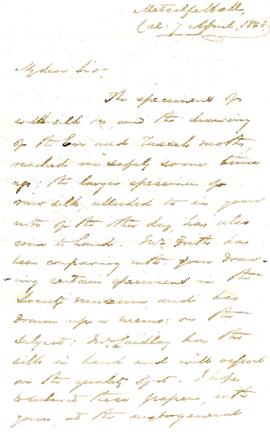
            Metcalf Hall
            Cal. 7 April 1848

            My dear Sir

            The specimens of wild silk etc and the drawing of the [Eri?] and Tussah moths reached me safely some time ago; the larger specimen of raw silk alluded to in your note of the other day, has also come to hand. Mr Frith has been comparing with your drawing certain specimens in the Society's Museum and has drawn up a Memo on the subject; Mr Laidlay has the silk in hand and will report on the quality of it. I hope to submit these papers, with yours, at the next general meeting of the Agricultural Society after which I will do myself the pleasure of addressing you more fully on the subject.
            Will you oblige me with a few leaves and flower of the Pooah plant for Dr. Falconer's examination? I presume you have seen Capt. Thompson's favourable report on the fibre.

            Yours very truly

            James Hume

            B.H. Hodgson
            Darjeeling

            Stamped Calcutta
            1846 Apr. 7

            Letter from James Hume to Brian Houghton Hodgson
            NZSL/HOD/5/4/25 · Item · 12 Jun 1848
            Parte de Non-ZSL Collections

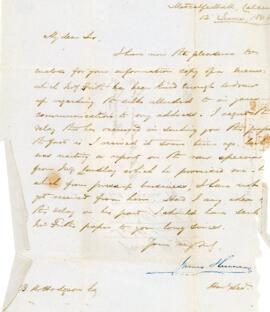
            Metcalf Hall, Calcutta
            12 June 1848

            My dear Sir,

            I have now the pleasure to enclose for your information copy of a Memo which Mr. Frith has been kind enough to draw up regarding the silk alluded to in your communication to my address. I regret the delay that has occurred in sending you this paper, the fact is I received it some time ago but was waiting a report on the raw specimens from Mr Laidlay which he promised me - but which, from present business, I have not yet received from him. Had I any idea of this delay on his part I should have sent Mr. Frith's paper to you long since

            Yours very [truly]
            James Hume
            Hon. Secy

            B.H. Hodgson Esq
            Darjeeling

            NZSL/HOD/5/4/27 · Item · [11] Feb 1857
            Parte de Non-ZSL Collections

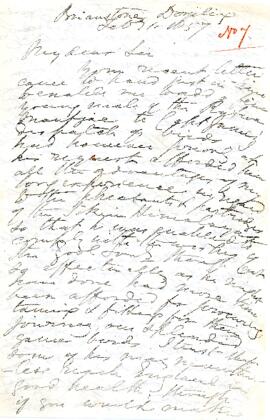
            Brianstone
            Dorjiling
            Feby [11] 1857

            My dear Sir,

            Your recent letter came to hand just in time to enable me to add a [few?] young [?] of the Rutwa Muntjac to Capt. James' despatch of birds I had however priorly at his his request afforded him all the advantages of my long experience in England of the pheasants and partridges of the Sikim Himalaya so that he was enabled to comply with the wishes of the Zool. Socy though not so [effectively] as he might have done had more time been afforded for procuring, taming and fitting for their journey our splendid game birds. I trust that some of his may nevertheless reach England in good health, though if you would make the [experiment?] of conveying these birds to Europe with all available chances of success, you should make your application, one season and, your transport of the birds, the next one, and so that the birds might be clear of the Bay of Bengal by the end of February. As it was it was too late to collect and quiet down the birds before they were sent off; and I apprehend that their embarcation will also be too late even if a sufficient quantity be forthcoming at Cala [Calcutta] when your Agent is ready to receive them and to convey them to England. Every thing depends on having birds duly prepared for the journey down the country, upon shipment at the [people?] season or height of the cold weather and upon ample room and careful supervision of the voyage. With all these advantages the birds may be assuredly conveyed home in high health, as I witnessed during my last voyage to England; without them here is but a doubtful chance of success. I request you will convey to the Committee my acknowledgements of their flattering attention to Dr. Horsfield and your suggestion for the illustrated publication of my Mammal novelties. Had I got this intimation a little sooner I could have forwarded with the Birds not only a fine live Ratwa or Kaker/Kacker which I did and beg to present the same to the society, but also, the [spoils?] of the wild Yak and of the Tibetan badger with one or two more rarities particularly a splendid skin of the Melanic variety of the leopard. But the intimation of your purpose came too late for that opportunity and the season is now so far advanced that the transmission of these skins, with any others I may get in the [interior?] had better be postponed till next season I have also now in the house a healthy and joyous individual of the Paradoxures tricus or the 5 striped species. But that is too great a pet to be parted with, though I may at all events be enabled to send you by and by an account of it's manners and habits as observed under circumstances of unusual advantage, I sent you long ago a drawing of a fine old male of Cervus Affinis I cannot hope to get a live sample but may procure more skins. Should I do so I will remember your wishes
            Very [truly] yrs

            B.H. Hodgson