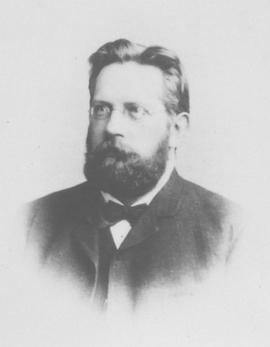
Ernest Abraham Hart was an English medical journalist. He was the editor of The British Medical Journal
Karel Johan Gustav Hartlaud was a German Physician and Ornithologist. Hartlaub was born in Bremen, and studied at Bonn and Berlin before graduating in medicine at Göttingen. In 1840, he began to study and collect exotic birds, which he donated to the Bremen Natural History Museum. He described some of these species for the first time. In 1852, he set up a new journal with Jean Cabanis, the Journal für Ornithologie. He wrote with Otto Finsch, Beitrag zur Fauna Centralpolynesiens: Ornithologie der Viti-, Samoa und Tonga- Inseln. Halle, H. Schmidt. This 1867 work which has handcoloured lithographs was based on bird specimens collected by Eduard Heinrich Graeffe for Museum Godeffroy. A number of birds were named for him, including Hartlaub's Bustard, Hartlaub's Turaco, Hartlaub's Duck, and Hartlaub's Gull

George James Finch-Hatton was a British peer and Tory politician
Joseph Henry was an American scientist who served as the first secretary of the Smithsonian Institution. He was the secretary for the National Institute for the Promotion of Science, a precursor of the Smithsonian Institution. He also served as president of the National Academy of Sciences from 1868 to 1878
Sir Hubert von Herkomer was a Bavarian-born British painter, pioneering film director and composes
Franz Martin Hilgendorf was a German zoologist and palaeontologist. Hilgendorf's research on fossil snails from the Steinheim crater in the early 1860s became a palaeontological evidence for the theory of evolution published by Charles Darwin in 1859. Darwin acknowledged the findings of Hilgendorf and referred to his research in the sixth edition of On the Origin of Species, 1872.