
Persona
·
fl 1939
Persona
·
1893-1949
Welsh poet and author
Persona
·
1879-1961
Neave was a British naturalist and entomologist. He was the grandson of Sheffield Neave, a governor of the Bank of England and the father of Airey Neave. He was born in Kensworth, Hertfordshire, the son of Sheffield Henry M. Neave and his wife Gertrude Charlotte Margaret (nee Airey). He was educated at Eton and Magdalen College, Oxford.
Neave's first work was research into the problems related to the tsetse fly and the study of African animal life. He was part of the Geodetic Survey of Northern Rhodesia between 1904 and 1905. Between 1906 and 1908 he was part of the Katanga Sleeping Sickness Commission and then from 1909 to 1913 the Entomological Research Committee of Tropical Africa.
He returned to the United Kingdom in 1913 and was appointed Assistant Director of the Imperial Institute of Entomology, becoming Director from 1942-1946. He was appointed as an officer of the Order of the British Empire in 1933 and a companion of the Order of St. Michael and St. George in 1941. From 1918 until 1933 he was Honorary Secretary of the Royal Entomological Society and was then its President in 1934-1935.
In 1934 he had the idea to compile an updated index of all published generic and subgeneric names in zoology, an activity which occupied the period 1935-1939, and resulted in the publication of his (initially) four volume 'Nomenclator Zoologicus' in 1939-1940. He also oversaw the preparation of a fifth volume, published in 1950.
Neave was Secretary of the Zoological Society of London from 1942. He retired in 1946 but carried on as Honorary Secretary until 1952.
Naeve married twice, firstly to Dorothy Middleton and they had two sons and three daughters, the eldest was Airey Neave, later a Member of Parliament. Dorothy died in 1942 and Neave married a second time to Mary Hodges in London in 1946.
Persona
·
1875-1955
Treasurer of the Zoological Society of London 1932-1945. He had been a Fellow since 1893, and a member of the Council almost continuously since 1907. In recognition of his many generous gifts of animals, he had been awarded the Society's Silver Medal in 1914. He was a banker and a member of J Henry Schroeder & Co
Persona
·
1784-1856
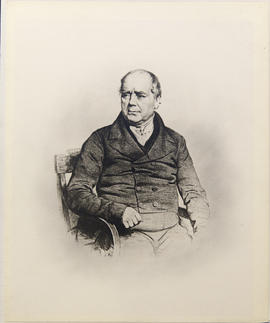
Yarrell was born in Duke Street, St James's in London, to Francis Yarrell and his wife Sarah (nee Blane). His father and uncle ran a newspaper agency and bookshop. He was educated at Dr Nicholson's School in Ealing. In 1802 he became a clerk with the Herries, Farquhar and Co. Bank. In 1803 he and his cousin, Edward Jones, joined his father's business. He acquired the reputation of being the best shot and best angler in London, soon becoming an expert naturalist. He sent many bird specimens to Thomas Bewick, who engraved them as woodcuts.
He joined the Royal Institution in 1817. His first publication was 'On the Occurrence of some Rare British Birds' (1825). This was published in the second volume of the 'Zoological Journal' and he later became one of that journal's editors. He was elected a Fellow of the Linnean Society in 1825. He wrote in 1827 on the structure of the tracheae of birds and on plumage changes in pheasants. He corresponded and shared specimens with other naturalists including Thomas Bewick, Sir William Jardine, Prideaux John Selby, Nicholas Aylward Vigors and Jonathan Couch.
Yarrell was one of the original members of the Zoological Society of London. In 1833, he was a founder of what became the Royal Entomological Society of London. He served for many years as treasurer both of the Entomological Society and the Linnean Society. Yarrell's major works were 'A History of British Fishes' (1836) and 'A History of British Birds (1843).
Yarrell died during a trip to Great Yarmouth and a memorial was erected in St James's Church, Piccadilly. He was buried in the churchyard of St Mary's in Bayford, Hertfordshire.
Yarrell had a number of species names after him, including the birds yellow-faced siskin (Carduelis yarrelli), the Chilean woodstar (Eulidia yarrelli) and the fish Yarrell's blenny (Chirolophis ascanii). The British subspecies of the white wagtail, the pied wagtail (Motacilla alba yarrelli) was also named after him.
Persona
·
1799-1869
Barlow was born in South Mimms, Hertfordshire, to his father Thomas WIlliam, a Clerk. He was educated at Blundell's School, after which in 1816 he started attending Trinity College, Cambridge. He earned his BA in 1820 and his MA in 1823. In 1822 he became the curate of the parish of Uckfield, Sussex. On 23rd March 1823 he was ordained as a priest. From 1830-1843 he was rector to the parish in Little Bowden, Northamptonshire. In 1824 he married Cecilia Anne Lam.
In 1832 Barlow joined the Royal Institution of Great Britain and he would serve many positions including Manager (1838), Secretary of the Lectures Committee (1841) and Honorary Secretary (1843-1860. Barlow was elected into the Royal Society in 1834 and served as Secretary of the Zoological Society of London from 1837-1838.
In 1851 Barlow became minister of the Duke Street Chapel, London and from 1854-1859 he was Chaplain-in-Ordinary at Kensington Palace.
Persona
·
1805-1873
Ogilby was probably born in County Londonderry in 1805, the illegitimate son of Leslie Ogilby. He was educated at a small academy kept by a clergyman in Macclesfield, before proceeding to Belfast Academical Institution and then to Trinity College, Cambridge in 1824. He graduated in 1828 and was called to the Bar by Lincoln's Inn in 1832. In 1827, he examined at Cambridge a living specimen of the species now known as the white-footed palm civet. He examined it again in London in August 1828, by which time he was sufficiently conversant with the organic structure of animals and the principles of taxonomy to recognise the creature as a previously undescribed species which he classified as an intermediate between the common genet and the common cat to which he assigned the name Paradoxurus leucopus. His description and classification of the animals appeared in a paper which was printed in the Zoological Journal of January 1829. The species he identified was included in Coenraad Temminck's 1839 monograph on the genus Paradoxurus.
His arrival in London gave him access to the works of Continental naturalists and to specimens of animals and birds held by the British Museum, the Zoological Society of London, the Linnean society and the East India Company. He became a regular visitor to the museums at Leiden and Paris, and he observed animals locomotion and behaviour at London Zoo, the Surrey Zoological Gardens at Newington, the Menagerie du Jardin des plantes and Paris and in the private collections such as that or Lord Derby.
From 1830 onwards, at meetings of the Zoological Society, he read explanatory papers and delivered commentaries on specimens donated to the Society's museum. Some forty of his reports were printed wither in full or abstract form are in the Society's Transactions and Proceedings during the years to 1841, describing and classifying new examples of mammals and birds from Australia, the Americas and India. In the same period he also read similar papers to the Linnaen Society and commented on fossil specimens to the Geological Society. Publication of his classifications established and named the several genera Cynictis (1833), Madoqua (1836), Pseudocheirus (1837), Chaeropus and Conilurus (1838), and placed many new species within previously established genera.
He chaired meeting of the Zoological Society of London from 1836, and by 1838 was not only one of its Fellows, but also a Fellow of the Linnean, Geological and Royal Astronomical Societies. In 1839 he was elected to the Council of the Zoological Society along with Charles Darwin, with Ogilby becoming the Society's Secretary shortly afterwards. In this latter capacity he conducted the Society's correspondence, controlled and catalogued its museum, recorded the animals in the zoological gardens and made recommendations for their purchase.
After his appointment as Secretary his contribution of scholarly papers and commentaries to the Zoological Society of London meetings declined. He last named a species (Cercopithecus tantalus - the Tantalus Monkey) in April 1841, and his final classification submission was made in January 1843. He continued as Secretary of the Society until resigning in 1847. He had been unremunerated in the post and was succeeded by a salaried official.
Ogilby inherited his father's Donagheady estate in 1845 just as the Great Famine was beginning to devastate Ireland. In December of the following year he tendered his resignation as Secretary of the Zoological Society, explaining that circumstances required his presence on the estate. He was elected a member of the Royal Irish Academy in 1849 and of the Natural History Society of Dublin in 1862. He was commissioned a captain in the Royal Tyrone Militia in 1851, served as High Sheriff of Country Tyrone in 1852, was a county magistrate by 1854 and appointed a Deputy Lieutenant in 1863.
In 1830 he married Matilda Doria, a daughter of Niccolo Doria, Marquese di Spineto. In 1836 Ogilby named a species of antelope (Antilope doria) in his wife's honour. She died in 1849. He later married Adelaide Douglas, the daughter of the local rector of Donagheady. They had four sons and five daughters. He died at 12 Earlsfort Terrace, Dublin, on 1st September 1873.

Persona
·
1829-1913
Sclater was born at Tangier Park, Wootton St Lawrence, Hampshire, where his father William Lutley Sclater had a country house. George Sclater-Booth, 1st Baron Basing was his elder brother. Philip grew up at Hoddington House where he took an early interest in birds. He was educated in school at Twyford, Winchester College and Corpus Christi, Oxford, where he studied scientific ornithology. In 1851 he began to study law and was admitted as a Fellow of Corpus Christi College. In 1856 he travelled to America and visited Lake Superior and the upper St. Croix River. Sclater wrote about this in his 'Illustrated Travels'. In Philadelphia he met Spencer Baird, John Cassin and Joseph Leidy at the Academy of Natural Sciences. After returning to England, he practiced law for several years and attended meetings of the Zoological Society of London.
In 1858 Sclater published a paper in the Proceedings of the Linnean Society, setting up six zoological regions which he called the Palaeartic, Aethiopina, Indian, Australasian, Neartic and Neotropical, which are still in use. He also developed the theory of Lemuria during 1864 to explain zoological coincidences relating to Madagascar to India.
He was Secretary of the Zoological Society of London for 42 years, from 1860-1902. He was briefly succeeded by his son, before the Council of the Society made a long-term appointment.
In 1874 he became private secretary to his brother George Sclater-Booth, MP. In 1875 he became President of the Biological Section of the British Association for the Advancement of Science, where he joined in 18447 as a member. He was elected as a member to the American Philosophical Society in 1873.
Sclater was the founder and editor of 'The Ibis', the journal of the British Ornithologists' Union. His office at 11 Hanover Square became a meeting place for all naturalists in London.
His collection of birds grew to nine thousand and he transferred them to the British Museum in 1886. At around the same time the museum was augmented by the collections of Gould, Salvin and Godman, Hume and others to become the largest in the world.
Among Sclater's books were 'Exotic Ornithology' (1866-1869), 'Nomenclator Avium' (1873), 'Argentine Ornithology' (1888-1889) and 'The Book of Antelopes' (1894-1900).
In June 1901 he received an honorary doctorate of Science from the University of Oxford.
In 1862 he married Jane Eliza Hunter Blair and they had one daughter and four sons. Their eldest son, William Lutley Sclater was also an ornithologist. Philip Sclater is buried in Odiham Cemetery.
Persona
·
1863-1944
Son of Philip Lutley Sclater and Jane Anne Eliza, the daughter of Sir David Hunter-Blair. He received his Master of Arts degree in Natural Science from Keble College, Oxford in 1885. He worked for two years as a Demonstrator at Cambridge and went on a collecting trip to British Guiana in 1886. He published about birds in the Ibis in 1887. In the same year he received an appointment as a deputy superintendent of the Indian Museum in Calcutta until 1891 when he joined the science faculty of Eton College. Sclater then took up the position of curator at the South African Museum, During his time in South Africa he continued his scientific writings, including the completion of the work 'Flora and Fauna of South Africa. In 1906, following a dispute with the Museum's board of trustees, Sclater resigned as curator. He travelled through Mombasa, Lake Victoria, Khartoum and Cairo before returning to England. He then moved to Colorado Springs, Colorado, which had been founded by his wife's brother-in-law, General William Jackson Palmer. Palmer offered Sclater a small estate outside the city and a professorship at Colorado College where he helped in reorganising the museum. When the general died in 1909, the couple returned to England.
From 1909 Sclater became curator of the Bird Room at the Natural History Museum. While working there he compiled the 'Systema Avium Aethiopicarum' (1924-1930). He worked there until his death.
In 1912 Sclater published 'A History of the Birds of Colorado' in two volumes. During World War One he volunteered for the Soldiers' and Sailors' Families Association.
Sclater was editor of 'Ibis' from 1913-1930, editor of the Zoological Record from 1921-1937, President of the British Ornithologist's Union from 1928-1933, and Secretary of the Royal Geographical Society 1931-1943. In 1930 he was awarded the Godman-Salvin God Medal. Known mainly for his work with birds, Sclater also described several new species of amphibians and reptiles. Four new species of snake were described by him in a single paper in 1891.
It was at Eton that he met his future wife, Charlotte Mellen Stephenson, an American divorcee whose two sons attended the school. They were married at St George's Cathedral in 1896. Both his stepsons were killed in action during World War One. In 1942 Charlotte died of injuries sustained during the bombing of London. In 1944 Sclater died at St George's Hospital, two days after a bomb fell on his home.
Persona
·
1864-1945
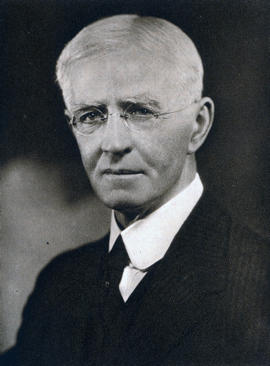
Mitchell was the son of Rev. Alexander Mitchell, a Presbyterian minister in Dunfermline, Scotland, and Marion Chalmers. He gained his MA at the University of Aberdeen, and then went to Christ Church, Oxford, where he read natural sciences, specialising in zoology. After his honours examination in 1888, he was appointed University Demonstrator in Zoology.
In 1911 he delivered the Royal Institution Christmas Lecture on 'The Childhood of Animals'.
In 1896 he was the anonymous author of an article in the Saturday Review entitled 'A Biological View of English Foreign Policy', which proposed the inevitability of a final battle between Britain and Germany, in which one would be destroyed. In February 1915 He gave three lectures on the subject of evolution and foreign policy at the Royal Institution that expanded on his 1896 article. These were combined and published in the form of a book entitled 'Evolution and the War' in May 1915. In April 1916, now an Army Captain, he was made responsible for setting up a specialist department MI7(B)4 to oversee the production of military propaganda to be dropped from the air over enemy lines.
He was Secretary of the Zoological Society of London from 1903-1935, second in length of office to his predecessor Philip Lutley Sclater. Mitchell's brainchild, Whipsnade Zoo, was opened in 1931 on the Dunstable Downs, Bedfordshire. In 1933 he was one of eleven people involved in the appeal which led to the foundation of the British Trust for Ornithology.
On retiring, he moved to Malaga, staying there during the first six months or so of the Spanish Civil War, until the city was taken on behalf of the rebels by Italian troops. An account of his last days in Malaga, including his arrest along with Arthur Koestler, is included in Koestler's book 'Spanish Testament' and in his own memoir 'My House in Malaga', published in 1938.
Mitchell died on 2nd July 1945 after being injured in an accident on 29th June outside London Zoo. After stepping off a bus, he was struck by a taxicab. A species of South American worm lizard, Amphisbaena mitchelli, is named in his honour. He also proved in the treatise 'On the Intestinal Tract of Mammals' that the caecum of mammals is directly homologous with the paired caeca of birds.