Personne
·
1873-1955
Pathologist at ZSL London Zoo
Pathologist at ZSL London Zoo
William Charles Linnaeus Martin was an English naturalist. He was the son of English naturalist and palaeontologist William Martin (1767-1810), who named him after the taxonomist Carl Linnaeus. Martin was the curator of the ZSL Museum from 1830-1839. After this he was a prolific natural history writer, authoring many books and articles. Forty-five of his papers appear in the Proceedings of the Zoological Society.

Francis Martin Duncan was born in 1873. He was ZSL Librarian and Clerk of Publications from 1919, taking over from previous librarian Henry Peavot's widow Maude who stepped into the role after Henry was killed during the war in France in 1917.
Duncan was also a skilled photographer, and is noted as having been a pioneer of applying the cinematograph to the movements of invertebrate and microscopic animals. He is also noted as having contributed greatly (along with his assistant) to the preparation of a new library catalogue and a geographical card catalogue.
He died in 1961
Anthony Salvin was an English architect, known mainly for house design in Tudor style and the restoration of a number of castles and churches. He was born in 1827 in Sunderland Bridge, County Durham to General Anthony Salvin Snr, and his second wife Elizabeth Mills. He was educated at Durham School, and for a time he worked under the Scottish architect John Patterson. He first moved to London in 1821 and is said to have worked in the office of John Nash. He was married in 1826 to his cousin Ann Andrews Nesfield with who he had 6 children, including the naturalist Osbert Salvin. He was awarded the royal gold medal from RIBA in 1863. He died in 1881 at his house Hawksfold in Fenhurst, Sussex.
The Zoological Club, connected with ZSL, was founded in 1866 by HW Bates, WH Flower, TH Huxley, PL Sclater, and others. The Club met to dine at various restaurants, including the Cafe Royal, before basing itself at London Zoo from 1914.
Member of London Zoo staff, probably Head Keeper
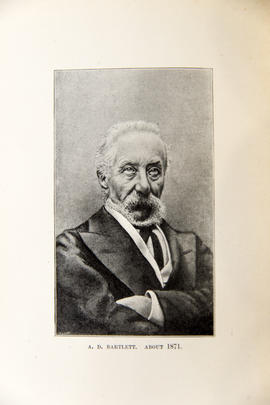
Abraham Dee Bartlett was the second son of John Bartlett and Jane Dunster. He was interested in animals as a child and his father's friend was Edward Cross, owner of the menagerie Exeter Exchange. He had a taxidermy business near the British Museum. Dead birds were sent to him for taxidermic preservation, and for his exhibits he received a gold medal at the Great Exhibition of 1851. He was among the first to reconstruct a specimen of the dodo, and this was displayed at Sydenham Crystal Palace, where he was appointed naturalist in 1852.
He associated himself with the Zoological Society of London and was offered the position of superintendent made vacant by the death of John Thompson at the garden in Regents Park in 1859. He was an agent for the acquisition of wild animals and was involved in their sale to circus agents. In 1882 he became unpopular after deciding to sell the African elephant Jumbo to P T Barnum. He became an authority on the care of wild animals and published papers in the Proceedings of the Zoological Society of London and other journals. He received a silver medal by the Society in 1872 and was made an associate of the Linnean Society in 1879.
Bartlett died in the zoo premises in 1897 after suffering from an illness. His son, Clarence, who had been assistant superintendent at the Zoo, took his position as superintendent. Another son, Edward, became a taxidermist and curator at the Maidstone Museum and the Raja Brooke's Museum. Several writings of Bartlett were published after his death in two books, 'Wild Animals in Captivity' (1898) and 'Life among Wild Beasts in the Zoo' (1900).
Superintendent of the Gardens 1897-1903
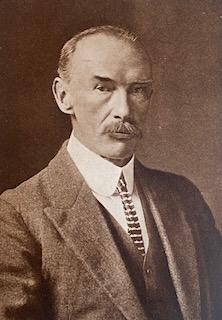
Pocock was born in Clifton, Bristol, the fourth son of Rev. Nicholas Pocock and Edith Prichard. He began showing interest in natural history at St Edward's School, Oxford. He received tutoring in zoology from Sir Edward Poulton, and was allowed to explore comparative anatomy at the Oxford Museum. He studies biology and geology at University College, Bristol. In 1885 he became an assistant at the Natural History Museum, and worked in the section of entomology for a year. He was put in charge of the collections of arachnida and myriapoda. He was also given the task to arrange the British bird collections, in the course of which he developed as lasting interest in ornithology. The 200 papers he published in his 18 years at the museum brought him recognition as an authority on arachnida and myriapoda; he described between 300 and 400 species of millipedes alone, and also described the scorpion genus Brachistosternus.
In 1904, he left to become Superintendent of London Zoo, remaining so until his retirement in 1923. He then worked as a voluntary researcher in the British Museum, in the mammals department.
He described the leopon in a 1912 to 'The Field', based on examination of a skin sent to him by W S Millard, the secretary of the Bombay Natural History Society.
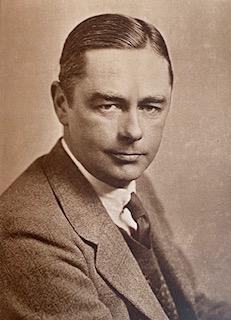
Born on 20th September 1890 at Hereford, he was the younger son of Henry Vevers, surgeon of Hereford, and he received his early education there before entering St Thomas' Medical School in 1909. On the outbreak of war in 1914, he went to Frances as a dresser with the British Red Cross Society but, after being sent back to qualify in 1915, he again served as Captain RAMC throughout the war in France until 1919, qualifying for the 1914-15 Star. He served as a casualty officer at St Thomas' and in 1919 became assistant helminthologist at the London School of Tropical medicine until 1923, having been awarded a Beit Memorial Fellowship during the years 1920-22.
He was honorary parasitologist to the Zoological Society of London from 1919 to 1921, and in 1921 was a member of the Filariasis Commission to British Guiana. In 1923 he was appointed Superintendent to the Zoological Society of London which he held until his retirement in 1948, receiving the Society's Silver Medal in 1942. In 1947 the Zoological Society of Glasgow and the West of Scotland awarded him its gold medal and he was also an honorary member of the Zoological Societies of Philadelphia and of Ireland. When the Society decided to start the collection at Whipsnade, he was chief assistant to the then Secretary, Sir Philip Chalmers Mitchell and he built a house for himself there as he had to do most of the fieldwork.
He paid several visits to Moscow where he succeeded in obtaining a number of rare animals and where he became a great admirer of the USSR, editing the Anglo-Soviet journal from 1939-1946.
As a student at St Thomas' he came a close friend of P H Mitchiner, who later became an honorary Fellow of the Zoological Society of London, and in 1946 Vevers was elected a Fellow of the College as a member of twenty or more years standing.
Vevers wrote numerous scientific papers and also books on natural history for children, on which subject he regularly broadcast in the BBC 'Children's Hour'.
He died on 9th January 1970 at his home Springfield, Whipsnade, and was survived by his wife and family