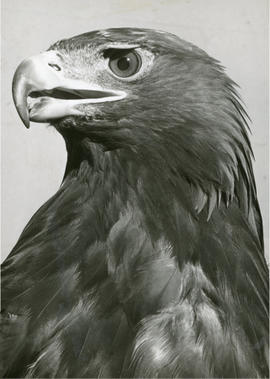
Goldie the Eagle was received from Helsinki Zoo on 16th December 1959. He was approximately seven years old when he escaped from London Zoo on 27th February 1965. Britain quickly became obsessed with the escape of Goldie; he appeared on television, in the press and was mentioned in the House of Commons. He flew from tree to tree in Regent's Park and was free for 11 days and 19 and a half hours before he was recaptured and brought back to the Zoo. Goldie escaped again on 15th December and was captured again on 19th December 1965. Goldie left London Zoo on 8th March 1985 when he moved to the Falconry Centre at Newent. He died there in March 1986
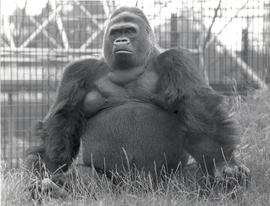
Guy came to London Zoo from the Zoo in Paris in exchange for a tiger. He arrived on 5th November 1947, Guy Fawkes Day, hence his name 'Guy'. He was just over a year old when he arrived, and was the first gorilla at London Zoo for six years. Over the years he became one of the most popular and loved animals in the history of the Zoo. While under anaesthetic for a dental operation in 1978, Guy died from a heart attack at the age of 32. Guy is commemorated by a bronze statue by William Timyn
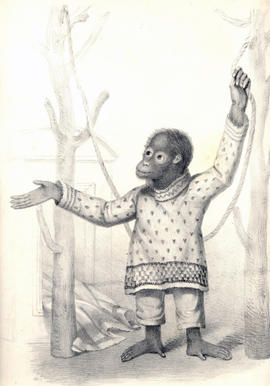
Jenny was the first Orangutan to be shown at London Zoo. She arrived on 25th November 1837, after being purchased from a Mr Moss for £150. She was put in the specially heated Giraffe House. She wore human clothing and learned to drink tea. She soon attracted excited crowds of people. On 28th March 1838, Charles Darwin came to London Zoo to see Jenny. It was his first sighting of an ape. He described Jenny in a letter: “the keeper showed her an apple, but would not give it her, whereupon she threw herself on her back, kicked & cried, precisely like a naughty child. - She then looked very sulky & after two or three fits of pashion [sic], the keeper said, 'Jenny if you will stop bawling & be a good girl, I will give you the apple.' - She certainly understood every word of his, &, though like a child, she had great work to stop whining, she at last succeeded, & then got the apple, with which she jumped into an arm chair & began eating it, with the most contented countenance imaginable.” The experience reinforced Darwin's view that human beings were 'created from animals'. Jenny died from an illness on 28th May 1839. After Jenny's death, she was replaced by another female Orangutan who, by tradition, was also named Jenny. The second Jenny was visited by Queen Victoria and Prince Albert
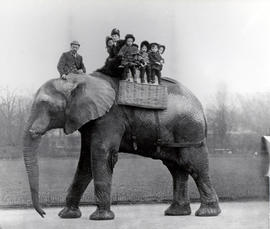
Jumbo was born about 1861. When still very small, he arrived at the Zoo in the Jardin des Plantes, Paris. In 1865 he was sent to London Zoo. On arrival he was in poor condition, but after being placed in the care of Matthew Scott, a former antelope keeper, he flourished. A female African elephant, Alice, arrived a few months later and the two elephants became associated in the public mind. Jumbo was trained to give rides and became a great favourite, largely because he had a very good nature. By the early 1880s Jumbo was nearly 11 feet tall. Jumbo was sold to P T Barnum who took him to the United States for exhibition in March 1882. Jumbo was killed in a railway accident in Canada in 1885.
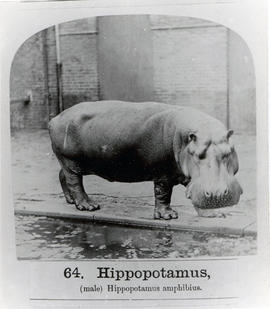
Obaysch was harpooned (bearing the scar all his life) when only a few days old, near an island in the Nile, from which he took his name. He arrived in London on 25th May 1850 and became the first hippo to reach Europe since the days of the Roman Empire. Despite lacking the engaging appearance and nature normally associated with Zoo stars, he quickly became the rage in London. Queen Victoria inspected him shortly after his arrival. In 1854 a female, Adhela, joined him. In 1871 Obaysch fathered London Zoo's first baby hippo. Sadly it did not survive. In 1872 two more were born, and the second of these, named Guy Fawkes because of its birthday (although subsequently discovered to be female), became the first captive-bred hippo to be reared by its mother. Obaysch died in 1878, while his hardly less popular daughter survived until 1908
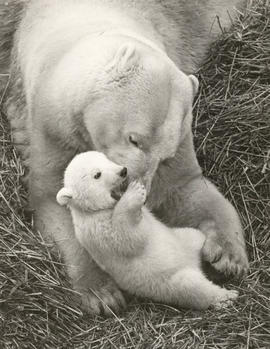
Pipaluk, a male polar bear, was born at London Zoo on 1st December 1967. The only polar bear cub previously reared successfully at the Zoo had been Brumas - a female. The name Pipaluk (the ending rhymed with book) was chosen from a list of Innuit names. It means 'the little one'. Pipaluk's parents, who had arrived as young cubs from Moscow Zoo in 1960, were called Sam and Sally. They were named after the Zoo's bear keeper, Sam Morton and his fiancee. Pipaluk left London Zoo in 1985 when the Mappin Terraces (which housed the bears) were closed, and died at the age of 22 in a zoo in Poland
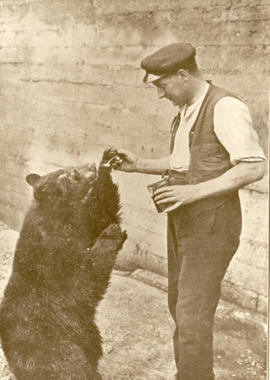
On 24th August 1914, en route to war in Europe, Lieutenant Harry Colebourn puchased a black bear cub at White River, Ontario. He called her Winnie after his home town in Winnipeg. Lt. Colebourn took her with him to England, where his regiment was training. The bear became the pet of the soldiers and the mascot of the regiment. She was left at London Zoo for safekeeping when the regiment went to fight in France. Lt. Colebourn had intended to take Winnie back to Canada with him when the war was over, and he often visited her at the Zoo when on leave. However, when the war ended, Lt. Colebourn donated Winnie to London Zoo in appreciated of the care that had been taken of her in those years, and in recognition that Winnie had become a great favourite with visitors. Winnie was said to have a remarkably good nature, was very tame, and could be stroked and played with. She used to give children rides and would also eat out of their hands. The author A.A. Milne and his son Christopher were frequent visitors to Winnie. As a result, Winnie the Pooh was named after her. Winnie died in 1934. A statue was presented to London Zoo by the people of Manitoba on 19th July 1995
Aquarium Research Fellow at ZSL from January 1928 until March 1931. She had a BSc awarded by the University of London in 1926. In 1928 she exhibited specimens at two ZSL Scientific Meetings, then in May 1929 presented a paper on the breeding habits and larvae of the tompot blenny, a marine fish. This was subsequently published during October of the same year in Proceedings of the Zoological Society (Brown, 1929)