Affichage de 21 résultats

Notice d'autorité
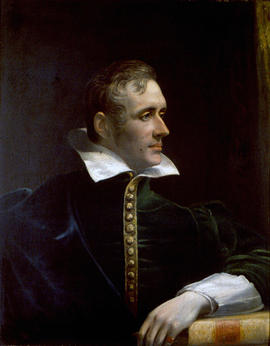
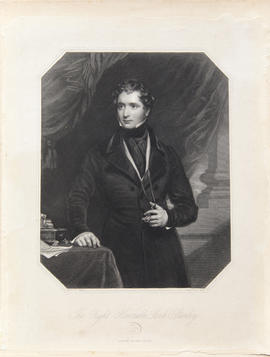
Stanley, Edward Smith
Personne · 1775-1851

Edward Smith-Stanley, 13th Earl of Derby was a politician, peer, landowner, builder, farmer, art collector and naturalist. He was the patron of the writer Edward Lear.

In 1834 he succeeded his father as 13th Earl of Derby and withdrew from politics, instead concentrating on his natural history collection at Knowsley Hall, near Liverpool. He had a large collection of living animals; at his death there were 1,272 birds and 345 mammals at Knowsley, shipped to England by explorers such as Joseph Burke. From 1828 to 1833 he was President of the Linnean Society. Several species were named after him. He was President of the Zoological Society 1831-1851.
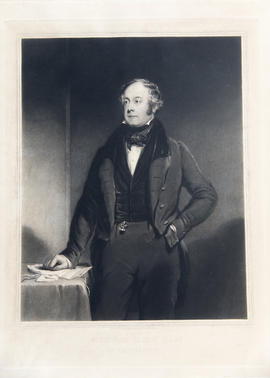
Clerk, George, Sir
Personne · 1787-1867

Sir George Clerk of Pennyculk, 6th Baronet was a Scottish politician who served as the Tory MP for Edinburghshire, Stamford and Dover. He was Chairman of the Royal Academy of Music and President of the Zoological Society of London 1862-1867.

Russell, Herbrand Arthur
Personne · 1858-1940

Herbrand Arthur Russell, 11th Duke of Bedford, was and English politician and peer. He was the son of Francis Russell, 9th Duke of Bedford, and his wife Lady Elizabeth Sackville-West, daughter of George Sackville-West, 5th Earl De La Warr.

He was President of the Zoological Society of London from 1899 to 1936, and was concerned with animal preservation throughout his life. He was instrumental in saving the milu (or Pere David's deer), which was already extinct by 1900 in its native China. He acquired a few remaining deer from European zoos and nurtured a herd of them at Woburn Abbey. He gifted Himalayan tahr to the New Zealand government in 1903.

Flower, William Henry, Sir
Personne · 1831-1899

Sir William Henry Flower was a surgeon, museum curator and comparative anatomist, who became a leading authority on mammals and especially on the primate brain. He supported Thomas Henry Huxley in a controversy with Richard Owen about the human brain and eventually succeeded Owen as Director of the Natural History Museum.

On the recommendation of Huxley and others, in 1862 he became Conservator of the Hunterian Museum of the Royal College of Surgeons of England, holding the post for 22 years, and in 1864 he was elected a Fellow of the Royal Society. In 1870 he became Hunterian Professor of Comparative Anatomy, in succession of Huxley, and began a series of lectures that ran for fourteen years, all on aspects of Mammalia. The essence was published in his books of 1870 and 1891. He was elected President of the Zoological Society of London in 1879, holding the post for life, and in 1882 was awarded the Royal Medal of the Royal Society. From 1883 to 1885 he was President of the Anthropological Institute.

In 1884, on the retirement of Sir Richard Owen, he was appointed to the directorship of what were then the Natural History departments of the British Museum in South Kensington. In 1889 he was chosen as President of the British Association for the Advancement of Science, having previously headed its biological section in 1878 and its anthropological section in 1881 (being chosen again in 1894). In 1893 he served as President of the Museums Association. In 1895, in addition to his role as Director he took over the post of Keeper of Zoology, holding it until his retirement.

Walden, Arthur Hay
Personne · 1824-1878

Colonel Arthur Hay, 9th Marquess of Tweeddale, known before 1862 as Lord Arthur Hay and between 1862 and 1876 as Viscount Walden, was a Scottish solider and ornithologist. He was President of the Zoological Society of London from 1868 . He had a private collection of birds, insects, reptiles and mammals, and employed Carl Bock to travel to Maritime Southeast Asia and collect specimens. Tweeddale described about 40 species collected by Bock for the first time and was elected a Fellow of the Royal Society in 1871.

Maurice, Henry Gascoyne
Personne · 1874-1950

Henry Gascoyne Maurice was President of the International Council for the Exploration of the Sea 1920-1938 and President of the Zoological Society of London 1942-1948. He also headed the Fisheries Department of the Ministry of Agriculture from 1912 and was Fisheries Secretary at the Ministry of Agriculture and Fisheries from 1920 until his retirement in 1938, after which he served on the White Fish Commission from its inception in 1938 until its suspension on the outbreak of the Second World War.

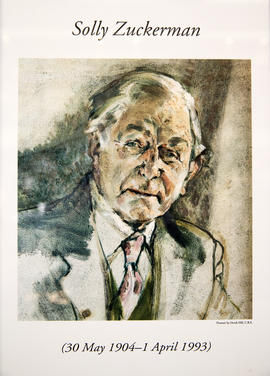
Zuckerman, Solomon
Personne · 1904-1993

Solomon 'Solly' Zuckerman was a British public servant, zoologist and operational research pioneer. He was born in Cape Town in 1904, the second child of Moses and Rebecca Zuckerman (nee Glaser). Both his parents were the children of Jewish immigrants from Russia. He was educated at the South African College School. After studying medicine at the University of Cape Town and later attending Yale University, he went to London in 1926 to complete his studies at the University College Hospital Medical School.

He began his career at the Zoological Society of London in 1928, and worked as a research anatomist until 1932. It was in this period that he founded the intellectual dining club, Tots and Quots. In 1932, he published his work 'Social Life of Monkeys and Apes'.

He taught at the University of Oxford from 1934 to 1945, during which time he was elected to a Fellowship of the Royal Society.

He was a scientific advisor to the Allies on bombing strategy in the Second World War, for his work to advance the cause of nuclear non-proliferation, and for his role in bringing attention to global economic issues.

Zuckerman married Lady Joan Rufus Isaacs in 1939 and they had two children. He died in London in 1993 following a heart attack.

Raffles, Thomas Stamford Bingley, Sir
Personne · 1781-1826

Thomas Stamford Bingley Raffles was born in 1781 on board the ship Ann, off the coast of Port Morant, Jamaica, to Captain Benjamin Raffles and Anne Raffles (nee Lyde). Raffles was a British statesman, Lieutenant-Governor of the Dutch East Indies (1811-1816), and Lieutenant-Governor of Bencoolen (1818-1824). He was the founder of modern Singapore and the Straits Settlements. Raffles was heavily involved in the capture of the Indonesian island of Java from the Dutch during the Napoleonic Wars. He wrote 'The History of Java'.

He was elected a member of the Linnaean Society on 5th February 1825. He was a founder and first president of the Zoological Society of London and the London Zoo.

Raffles died at Highwood House in Mill Hill, north London, on 5th July 1826, of apoplexy. He was survived by his second wife Sophia Hull and daughter Ella.

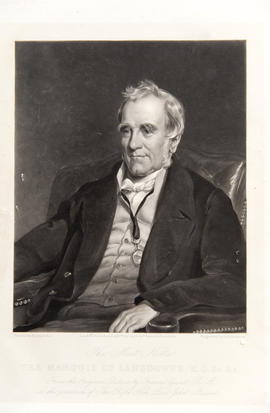
Petty-Fitzmaurice, Henry
Personne · 1780-1863

Henry Petty-Fitzmaurice, 3rd Marquess of Lansdowne, known as Lord Henry Petty from 1784-1809. He was the son of Prime Minister William Petty, 1st Marquess of Lansdowne (known as the Earl of Shelburne) by his second marriage to Lady Louisa, daughter of John FitzPatrick, 1st Earl of Upper Ossory. He was educated at Westminster School, the University of Edinburgh and Trinity College, Cambridge. He was a British Statesman and served as Home Secretary, Chancellor of the Exchequer and was three times Lord President of the Council.

He was President of the Zoological Society of London 1827-1831.

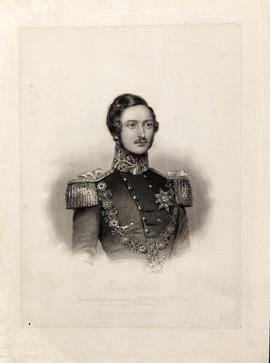
Francis Albert Augustus Charles Emmanuel
Personne · 1819-1861

Prince Albert of Sax-Coburg and Gotha was the consort of Queen Victoria from their marriage on 10th February 1840 until his death in 1861. He was President of the Zoological Society of London 1851-1862.